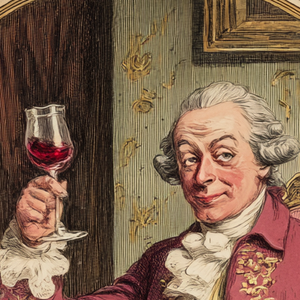
One of the great consolations of advancing years — and there are fewer than the poets would have us believe — is the deepening of one's acquaintance with whisky. A young man drinks for effect; a man of experience drinks for conversation, by which I mean the conversation between the spirit and the palate, that quiet dialogue which unfolds over the course of an evening and which no amount of wine-column jargon can adequately describe.
This week the subject of our interview is the Highland Park 18 Year Old, distilled in Kirkwall, Orkney — which is to say, at the very edge of the known world, in a place where the Vikings once built their fires and where the wind has not stopped blowing since. The nose, upon first acquaintance, is honeyed and floral, with an undertone of wood smoke that suggests a peat fire in a well-furnished room. There is heather in there, and something of salted caramel, and — if one waits — a faint maritime note, as of sea air through an open window. On the palate, the whisky is generous and warm: dark fruits, spice, a measured sweetness that never becomes cloying. The finish is long and dignified, like the final movement of a symphony one is sorry to see end. A drop of water opens it further, revealing depths I had not suspected on the first pass. This is not a whisky for hurrying. It repays patience.
There is something rather magnificent about the circumstance that brings a spirit to maturity. Highland Park 18 spends its years in casks, some of them previously used for sherry, others for bourbon — and the wood speaks as clearly as the grain. You taste not merely the distiller's art but the cooper's craft. The barrel is not mere container but partner in creation. Eighteen years is a considerable span of time for a whisky to spend in wood. In that time, the raw distillate transforms. The harsh edges soften. The flavours grow complex and integrated. The spirit becomes, in a real sense, philosophical.
And the place! One cannot ignore the influence of place. Orkney is remote — a archipelago far to the north, where the mainland seems almost a legend. The whisky that emerges from Kirkwall carries something of that remoteness in its character. It is not a whisky that seeks to please indiscriminately. It has an austere quality, a kind of Presbyterian austerity dressed up in rich clothing. It asks something of the drinker: attention, patience, a willingness to linger. Those who are accustomed to the softer, rounder whiskies of the Speyside may find Highland Park rather more demanding. But therein lies its distinction. This is a whisky for contemplation, for serious conversation, for evenings when one has nowhere to be but in the present moment.
The peat is present but restrained — not the aggressive peat of the Islay whiskies, but something more subtle, more integrated. It serves rather than dominates. Think of it as the bass line in a symphony — essential to the overall harmony but never the loudest instrument. And yet, spend an evening with this whisky and you will find that the peatiness becomes almost poetic. It speaks of moorland, of long light in summer, of the turn of seasons in a place where seasons turn quite slowly.
My verdict, then, is this: Highland Park 18 is a whisky of genuine character and distinction. It is not the whisky one drinks casually — it demands and deserves proper attention. It is the whisky one reaches for when there is something worth celebrating or something worth forgetting, and one has the time to do either justice. It connects one, quite directly, to place — to the grey waters of the North, to the ancient stones of Kirkwall, to the whole long history of whisky-making in this remote corner of the world. That alone makes it worthy of the price. The fact that it is also delicious is, one might say, merely the modest icing upon a rather excellent cake.