From the Library
On the Matter of Boswell's Johnson, & Whether a Man May Be Known by His Table-Talk

Friday, the 28th of March, 2026
By Professor Quarto
It is a truth insufficiently acknowledged that the greatest biography in the English language is, at bottom, a record of dinner conversation. Boswell's Life of Samuel Johnson derives its immortality not from the bare facts of Johnson's career — which were, by any conventional measure, rather more turbulent than triumphant — but from the astonishing vitality of the man's talk. And where did this talk chiefly occur? At table. In taverns. Over mutton and port. One does not exaggerate to say that English literature's most enduring monument was built upon a foundation of roasted meat and good claret.
Continue reading…
From the Kitchen
In Defence of the Turnip, That Most Unjustly Maligned of Roots
Wednesday, the 26th of March, 2026
By The Trencherman
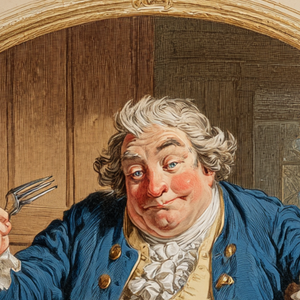
Let me tell you something about turnips. The turnip has been getting a raw deal for the better part of three centuries, and I for one have had enough of it. Every other root vegetable has had its moment of fashionable rehabilitation — the parsnip is now darling of the gastropub set, the beetroot has been elevated to salad royalty, and the sweet potato appears to have been granted a permanent seat at every table in America. But the humble turnip? Still consigned to the back of the crisper drawer, still boiled to grey submission by cooks who never bothered to learn what it could become.
Continue reading…
From the Cellar
Whisky of the Week: Highland Park 18, or, A Meditation on Orkney & Antiquity

Tuesday, the 25th of March, 2026
By Sir Lushington
One of the great consolations of advancing years — and there are fewer than the poets would have us believe — is the deepening of one's acquaintance with whisky. A young man drinks for effect; a man of experience drinks for conversation, by which I mean the conversation between the spirit and the palate, that quiet dialogue which unfolds over the course of an evening and which no amount of wine-column jargon can adequately describe.
Continue reading…
At Table
Dinner at Vetri Cucina, Philadelphia: A Convivial Inquiry into Pasta, Propriety, & the Correct Wine
Saturday, the 22nd of March, 2026
Being a dialogue between Sir Lushington, Professor Quarto, & The Trencherman
The scene: a corner table at Vetri Cucina, Spruce Street, Philadelphia. The bread has arrived. The Trencherman is already eating it.
The Trencherman:
This bread. This bread. Feel the crust on that — you could tap it on the table and it would ring like a bell. And they've given us proper butter, not that whipped nonsense. I am already well-disposed toward this establishment and we haven't ordered.
Sir Lushington:
I note that the wine list runs to fourteen pages, which I consider a mark of serious intent. They've a Barolo from Giacomo Conterno that I've had my eye on for some months, and a most intriguing selection of wines by the glass. I have begun with the Vermentino, which is crisp and faintly saline and exactly what one wants before a meal of this kind.
Professor Quarto:
You will forgive me if I observe that we are dining in a city where Benjamin Franklin once took his meals, and that the Italian culinary tradition in Philadelphia stretches back to the great immigration of the 1880s. Vetri sits at the apex of that tradition. There is something moving about eating this well in a city that has been feeding people seriously for three centuries.
The Trencherman:
Professor, I admire your learning, but the spinach gnocchi have arrived and I must insist on silence while I attend to them.
Read the full review…
The Commonplace Book
On Wine in Homer, & What Odysseus Understood About Drinking
Thursday, the 20th of March, 2026
By Sir Lushington
In my recent return to the Odyssey — prompted by Professor Quarto, who has been on a Hellenic tear and will not rest until everyone within earshot has read their Homer — I was struck again by how central wine is to the machinery of that great poem. Not as background detail, but as a tool of civilization itself. When Odysseus defeats the Cyclops, he does so with wine — a gift so potent it renders the monster insensible. The lesson is plain: the man who understands wine conquers the brute who does not. One might call it the founding myth of the sommelier's profession.
Continue reading…