

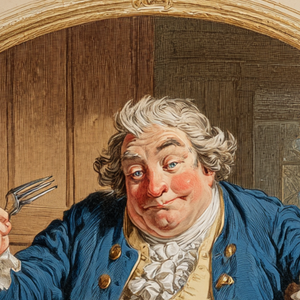
The scene: a corner table at Vetri Cucina, Spruce Street, Philadelphia. The bread has arrived. The Trencherman is already eating it.
The Trencherman:
This bread. This bread. Feel the crust on that — you could tap it on the table and it would ring like a bell. And they've given us proper butter, not that whipped nonsense. I am already well-disposed toward this establishment and we haven't ordered.
Sir Lushington:
I note that the wine list runs to fourteen pages, which I consider a mark of serious intent. They've a Barolo from Giacomo Conterno that I've had my eye on for some months, and a most intriguing selection of wines by the glass. I have begun with the Vermentino, which is crisp and faintly saline and exactly what one wants before a meal of this kind.
Professor Quarto:
You will forgive me if I observe that we are dining in a city where Benjamin Franklin once took his meals, and that the Italian culinary tradition in Philadelphia stretches back to the great immigration of the 1880s. Vetri sits at the apex of that tradition. There is something moving about eating this well in a city that has been feeding people seriously for three centuries.
The Trencherman:
Professor, I admire your learning, but the spinach gnocchi have arrived and I must insist on silence while I attend to them.
A pause. The gnocchi are consumed with evident satisfaction.
The Trencherman:
Right. Those gnocchi were extraordinary. Lighter than air — how they achieve that texture with spinach I cannot fathom. The brown butter had been taken just past golden into something nutty and deep, and there was a whisper of sage that didn't bully the dish. If I had to eat one course for the rest of my days, that would be a serious contender.
Sir Lushington:
I have moved to the Nebbiolo and I'm rather glad I did. It has that tarry, rose-petal quality one hopes for — just enough tannin to stand up to what I suspect is coming next.
Professor Quarto:
What is coming next is the salt-crusted branzino, and I must tell you that the practice of baking a whole fish in a salt crust dates to at least the fourth century — Apicius describes something remarkably similar, though he would have used garum rather than the lemon and capers our waiter has just promised. The continuity of the tradition is what moves me. We are eating as the Romans ate, more or less, in a building made of steel and glass. Civilization is a marvellous thing.
The Trencherman:
Civilization is a marvellous thing, Professor, but so is the fact that they've just cracked that salt crust open and the fish inside is flawless. Perfectly moist, the skin just barely holding together, and that sauce — oil, lemon, a few capers, nothing more. This is cooking that knows when to stop. I respect that enormously.
Sir Lushington:
I shall conclude by noting that the after-dinner grappa selection is superb — I chose a grappa di Amarone that was smooth as silk and carried the faintest memory of dried cherries — and that the service throughout was attentive without being theatrical. This is a restaurant that trusts its food to do the talking, and wisely so. We shall return.
The bill is settled. A pause. The waiter presents the dessert menu.
The Trencherman:
Now then. I see they've a panna cotta with amaretto and candied orange. I confess that after gnocchi of that caliber and a branzino of such distinction, I am prepared to believe that their panna cotta might be something rather special.
Professor Quarto:
The panna cotta, as a form, has been much abused in recent decades. Too often it is a mere vehicle for gelatin and nostalgia. However, I have great faith in establishments that understand restraint in their savoury courses — they tend to understand it in their sweet courses as well. I shall have it.
Sir Lushington:
I am more inclined toward the dark chocolate torte, which our waiter assures me comes with a sauce of Barolo reduction. The prospect of Barolo in liquid form, carefully reduced to something essential, is quite appealing. One might almost call it the perfect conclusion to an evening spent discussing Italian wines.
The desserts arrive. The Trencherman takes a spoonful of panna cotta and nods his approval. A moment of reverent silence.
Professor Quarto:
You know, there is something rather perfect about this moment. We have travelled through an entire meal — from bread, through pasta, through fish — and we arrive at a panna cotta that tastes precisely as panna cotta ought to taste. It is a small thing, really, but it says everything about a restaurant's philosophy. They could have made it more elaborate, more interesting, more fashionable. Instead, they made it perfect.
The Trencherman:
Perfectly said, and this chocolate torte — Sir Lushington, is that Barolo reduction as magnificent as one might hope?
Sir Lushington:
It is, my dear Trencherman, it is. The wine has been reduced to its essential character — all the dark fruit, all the structure, but concentrated, intensified. It cuts through the richness of the chocolate without overwhelming it. The two speak to each other rather than competing. It is the work of someone who understands that wine and food are not adversaries but companions.
They sit contentedly for a moment. The evening grows late. The restaurant around them has grown quieter — a few tables remain, conversations hushed, the air thick with satisfaction.
Professor Quarto:
May I propose a final observation? We have spent an evening — some four hours or so — in this restaurant, and not once has the kitchen attempted to impress us with difficulty for its own sake. There was no foam, no deconstruction, no ironic twists on tradition. Instead, what we found was excellence pursued through understanding. Understanding of ingredients, of technique, of the relationship between wine and food, of what people actually want when they sit down to eat.
Sir Lushington:
Excellently put, Professor. And I should add: understanding of the relationship between people at table. This restaurant understands that dining is fundamentally a social act. The food is excellent, certainly, but the excellence serves the conversation. We have not been made to feel that we ought to be silent in reverence of the plate.
The Trencherman:
Well, I'm not inclined to philosophize when there's good chocolate to attend to, but I'll say this: they understood that good cooking is not about showing off. It's about respect — respect for the ingredients, respect for the tradition, and respect for the people eating. That's rare. That's worth coming back for.
The evening concludes. As they prepare to leave, the proprietor appears with a small plate of petit fours — a gift to returning friends. Such is the way of restaurants that understand their business.